Stern unterliegt Lense-Thirring-Effekt von Sagittarius A*
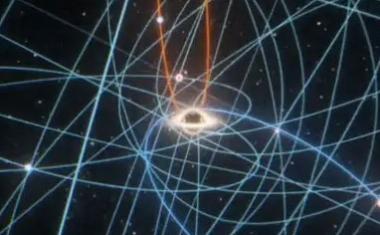
S301 ist dem zentralen Schwarzen Loch der Milchstraße näher als jedes andere bekannte Objekt.

 • 10/2026 • Seite 40 • DPG-Mitglieder
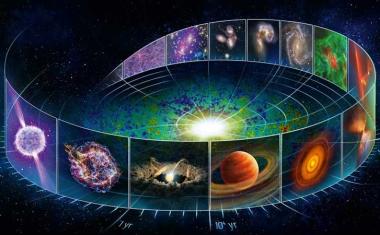
Der Exzellenzcluster „Unser dynamisches Universum“ erforscht die Evolution
des Universums auf allen Zeitskalen.
Sekundenschnelle Fast Radio Bursts oder Supernovae sind für die Dynamik des Universums ebenso wichtig wie die Sternentstehung, die mehrere Millionen Jahre in Anspruch nimmt, oder die Entwicklung der Galaxien über Milliarden von Jahren hinweg. Das Ziel des Exzellenzclusters „Unser dynamisches Universum“ (Dynaverse) ist es zu untersuchen, wie sich die Ereignisse auf kurzen Zeitskalen und die langfristigen Prozesse gegenseitig beeinflussen, um die Dynamik des Universums besser zu verstehen. Dafür vereint der Cluster Expertise für Instrumentenentwicklung, Beobachtungen, Simulationen, Laborastrophysik und Astroinformatik.
Dynaverse ist eine Kooperation zwischen der Universität zu Köln, der Universität Bonn, dem Max-Planck-Institut für Radioastronomie und weiteren Institutionen (Infokasten). Die beiden Universitäten arbeiten in der Astronomie bereits seit vielen Jahren eng zusammen, unter anderem im Rahmen von Sonderforschungsbereichen. Zu den gemeinsamen Projekten zählen zudem der Bau und Betrieb des Fred Young Submillimeter Telescope in Chile zusammen mit internationalen Partnern.
Die Forschung im Cluster fokussiert sich auf drei „Astrophysical Research Challenges“. Die erste beschäftigt sich mit der Zeitraffer-Astronomie, also mit Phänomenen im Universum, die auf so langen Zeitskalen stattfinden, dass sie sich nicht in Echtzeit verfolgen lassen. Dazu gehören die Galaxienentwicklung sowie die Stern- und Planetenentstehung und der damit verbundene Transport von Staub und Gas über viele Skalen hinweg.
In der Zweiten geht es um die Zeitlupen-Astronomie, die sich auf kurzzeitige, also transiente Ereignisse wie Supernovae, Radioblitze oder die Verschmelzung von Schwarzen Löchern konzentriert. Diese meist sehr energiereichen Phänomene können ganze Galaxien beeinflussen, was eine Verbindung zur ersten Research Challenge herstellt. Um Wechselwirkungen zwischen transienten Ereignissen und den Entwicklungen auf langen Zeitskalen genau zu verstehen, sind neben detaillierteren Beobachtungen auch umfangreiche Simulationen notwendig, welche die unterschiedlichen Skalen miteinander koppeln.
Die dritte Research Challenge zielt auf „Cosmic Twists“ ab, also Wendepunkte in der Evolution des Kosmos, die einmalig auftreten und das gesamte Universum für immer verändern. Dazu zählen die kosmische Inflation, also die exponentielle Expansion des Universums direkt nach dem Urknall, die Phase der Reionisation kurz nach der Entstehung der ersten Sterne und Galaxien und der Zeitpunkt, seit dem die Dunkle Energie über die sichtbare und Dunkle Materie dominiert. (...)
S301 ist dem zentralen Schwarzen Loch der Milchstraße näher als jedes andere bekannte Objekt.
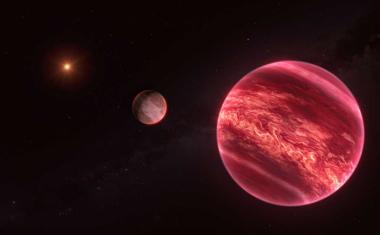
Mondähnliches Objekt umkreist einen Braunen Zwerg – ist es im Sprachgebrauch ein Planet oder ein Mond?
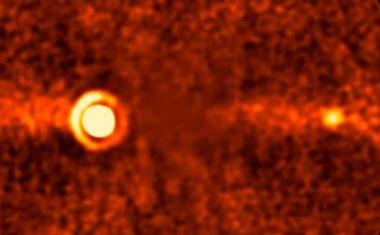
Beta Pictoris d nach mehr als zehn Jahren Versteckspiel mit VLT und JWST direkt abgebildet.

VLT- und James-Webb-Weltraumteleskop-Daten lassen Ursprung in einem betagten Sternsystem vermuten.

Internationales Team evaluiert Ansatz für die Beobachtung von erdähnlichen Exoplaneten mit Großteleskopen und einem Abschirmsatelliten.
Complex sputtered dielectric coatings enable high LIDT, low losses, and dispersion control for apertures up to 550 mm.
TOPTICA’s high-power sodium guide star lasers push the frontiers of adaptive optics

Durchmusterung mit ALMA enthüllt komplexes Netzwerk aus Filamenten kosmischen Gases in bisher unerreichter Detailgenauigkeit.

AES Andes rückt von Plänen ab – Bedrohung durch Lichtverschmutzung und Vibrationen für die chilenische Großsternwarte abgewendet.
Mit einem Offenen Brief fordern Nobelpreisträger Reinhard Genzel und weitere Astronom:innen dazu auf, den Nachthimmel über dem Paranal-Observatorium der ESO zu schützen.

„Exoplaneten und ihre Atmosphären“ konzentriert sich auf Klima und Atmosphäre ferner Welten.

Auswirkungen der Strahlung eines Quasars auf die innere Struktur des Gases einer benachbarten Galaxie beobachtet.
Zwei Initiativen wollen die Position der Wissenschaft in der Weltpolitik stärken.

Geplanter Industriekomplex in der Nähe des Paranal würde die Beobachtungen der besten astronomischen Einrichtungen massiv verschlechtern.

Komplexe Wettermuster mit starken Winden, die Eisen und Titan transportieren.

Stärkster je gemessener Jetstream auf einem Gasriesen beobachtet.

Winzige Detail um supermassereiches Schwarzes Loch bei thermischen Infrarotwellenlängen aufgenommen.

Nur fünf bis elf Kilometer von den Teleskopen auf dem Paranal entfernt soll ein riesiger Industriekomplex entstehen.

Gas und Staub zeigen, dass sich der Doppelstern in der Nähe des supermassereichen schwarzen Lochs gebildet haben muss.
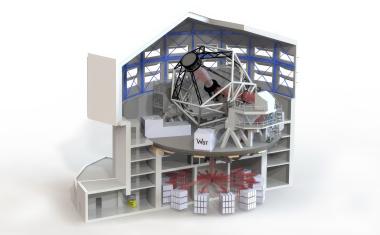
EU sichert Finanzierung für die Konzeption des für 2040 geplanten Teleskops.

Mit Katja Poppenhäger wird erstmals eine Frau Direktorin am Leibniz-Institut für Astrophysik Potsdam.

Entdeckung ergänzt wachsende Liste massearmer Planeten um rote Zwerge.

Die „Highlights der Physik“ fanden im Herzen Hannovers statt.

Zwei große Instrumente für das Extremely Large Telescope bestehen die Designprüfung.
 • 9/2024 • Seite 63 • DPG-Mitglieder
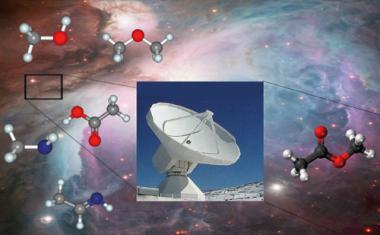
The study of molecules with large amplitude motions takes us on a journey from molecular structure to astrophysics.
Spectroscopy allows us to use light to explore, detect and quantify molecules in the interstellar medium, in the atmospheres of planets and exoplanets, in comets, stars, and so on. Spectroscopy also makes it possible to determine the three-dimensional structure of complex molecules and of molecules that form the building blocks of biological molecules (biomimetics). Gas phase spectroscopy gives information about intramolecular dynamics occurring in molecules.
Internal rotors are molecules containing an atom or a group of atoms that can rotate through a torsional angle α relative to the other parts of the molecule. This motion is hindered by a potential barrier, so the internal rotation is not “free” (Fig. 1). Internal rotation or torsion is called Large Amplitude Motion (LAM) because the internally rotating group of atoms moves far away from equilibrium positions compared to the bond lengths.
V(α) is the internal rotation potential function (Fig. 1), which has a 2π/3 periodicity for a methyl rotor top (–CH3). It can be expressed in the following Fourier series in terms of the torsional angle α, the leading term V3 is called the height of the barrier [1, 2]: (...)
Neu identifiziertes Schwarze Loch bringt umliegende Sterne innerhalb eines Sternhaufens zu geordneter Bewegung.

Wichtiges Modul für das Extremely Large Telescope in der Atacama-Wüste geht auf die Reise.

Spektrograph ANDES wird am Extremely Large Telescope nach Anzeichen von Lebensformen suchen.

Wasserdampf in der Scheibe um einen jungen Stern gefunden – genau dort, wo möglicherweise Planeten entstehen.

Eine der größten jemals durchgeführten Durchmusterungen von planetenbildenden Scheiben.

Die Migration von Planeten könnte erklären, warum Exoplaneten mit doppeltem Erdradius selten sind.

Linda Tacconi erhält die Caroline-Herschel-Medaille 2024.

Klare Hinweise auf Entstehung eines kompakten Objekts direkt nach einer Sternexplosion gefunden.
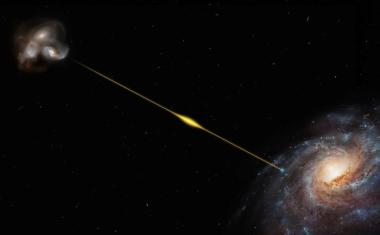
Extragalaktische Radioausbrüche helfen bei der Suche nach fehlender Materie.
Eine Überarbeitung des Verhaltenskodex der IAU stößt nicht nur auf Gegenliebe.
Indien investiert einen Milliardenbetrag in seine neue Agentur für Grundlagen- und angewandte Forschung.

Rätselhafte Wechsel zwischen zwei Emissionsarten durch Materieauswürfe bedingt.

Neue Aufnahmen zeigen Materialklumpen um einen jungen Stern.

Extremely Large Telescope ist bereits halb fertiggestellt.

Untersuchungen an Trappist-1 c liefert wichtige Erkenntnisse zur Analyse von Exoplaneten-Atmosphären.

Bau wichtiger Teilsysteme des Extremely Large Telescope hat begonnen.

Riesiger Infrarot-Atlas von fünf nahe gelegenen Sternentstehungsgebieten veröffentlicht.

Das BlackGEM-Array am La Silla-Observatorium hat seinen Betrieb aufgenommen.
Astronet hat einen strategischen Plan für die europäische Astronomie für die Jahre 2022 bis 2035 vorgelegt.
Die Planungen für das Einstein Discovery Center in Ulm werden konkreter.

Großes Reservoir an heißem Gas um die Spiderweb-Galaxie entdeckt.

Gasförmiges Wasser in planetenbildender Scheibe gibt Hinweis auf Herkunft von Wasser.

Erdähnlicher Planet umkreist Zwergstern in der habitablen Zone.

Die ESO feiert 60 Jahre internationaler Zusammenarbeit mit der Aufnahme einer Sternenfabrik.

Analyse von Quasaren erlaubt Neubestimmung der Epoche der Reionisation.

Während seine globale Temperatur sinkt, erwärmt sich der Südpol des Planeten.

Dimethylether als bislang größtes Molekül in Planeten bildender Scheibe nachgewiesen.

Indizien für einen weiteren Exoplaneten bei Proxima Centauri verdichten sich.

Größte jemals entdeckte Gruppe von Einzelgänger-Planeten liefert wichtige Erkenntnisse zu deren Herkunft.

Jahresrückblick Astrophysik 2021.

Bislang genaueste Messung eines knappen Sternvorbeizugs an Sagittarius A*.

Planet im Orbit um das bisher massereichste Sternpaar entdeckt.

Exoplaneten waren während ihrer Entstehung nicht von massiven Einschlägen und betroffen.

Zwei supermassereiche schwarze Löcher umkreisen sich in viel geringerem Abstand als jedes andere bekannte Paar.
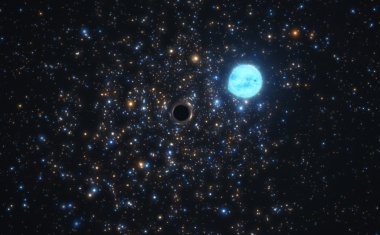
Erstmals schwarzes Loch außerhalb der Milchstraße per Radialgeschwindigkeitsmethode entdeckt.

Die Astronomie-Community in den USA veröffentlicht ihre Prioritäten und Ziele für die Jahre 2023 bis 2033 und darüber hinaus.

Uralte Galaxie zeigt deutliches Signal an Fluorwasserstoff, vermutlich aus Wolf-Rayet-Sternen.

Neues Fotoalbum der größten Asteroiden im Sonnensystem.

Spektroastrometrie erlaubt Untersuchung leuchtkräftiger Quasare im frühen Universum.

Leichtester per Radialgeschwindigkeitsmessung gefundener Planet hat nur die halbe Masse der Venus.
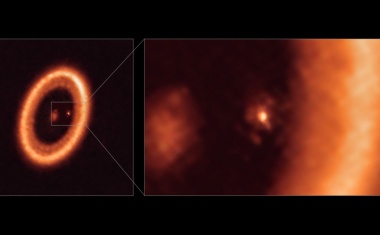
Erstmals mondbildende Scheibe um Jupiter-ähnlichen Exoplaneten nachgewiesen.

Beobachtung naher Galaxien liefert großen Überblick über Stadien der Sternenstehung.
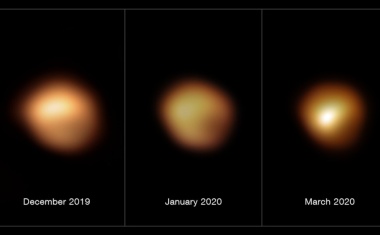
Ursache für ungewöhnlichen Helligkeitseinbruch geklärt.

Schwermetalle in der Atmosphäre von Kometen in mehreren Astronomischen Einheiten Entfernung sowie auf 2I/Borisov gefunden.

Erstmals gelingt die Beobachtung von Stratosphärenjets auf dem Gasriesen.

Ungewöhnliches stellt Theorien über die Entstehung von Planeten in Frage.

Das Ereignis wurde wahrscheinlich durch eine Kollision mit einer anderen Galaxie ausgelöst.
In Südafrika haben astrometrische Beobachtungen seit 200 Jahren Tradition.

Simulationen lassen schützende Rolle von Gasriesen für erdähnliche Planeten erwarten.

Supermassereiches schwarzes Loch verschlingt große Teile eines vorbeifliegenden Sterns.

Phosphin in Wolken nachgewiesen – Konzentration liegt über bekannten abiotischen Prozessen.

Forscher analysieren sowohl Einfluss auf Beobachtungsqualität als auch forschungsbedingten CO2-Ausstoß.

Drei Zentralsterne zerren an planetenbildender Scheibe bei GW Orionis.

Hochgeschwindigkeitsstern erreicht Rekordwert von 24.000 Kilometern pro Sekunde.

Weit entferntes Ebenbild unserer Galaxie wirft Fragen zur Galaxienentstehung auf.

Very Large Telescope schießt das Bild eines Mehrplanetensystems.

In einer Zwerggalaxie fehlt ein Stern – ist er zu einem schwarzen Loch kollabiert?
Das European Southern Observatory hat ein neues Verfahren getestet, um Beobachtungszeiten zuzuweisen.
Das europäische Strategieforum äußert sich zur Entwicklung der europäischen Forschungsinfrastrukturen.

Schwarzes Loch im Zentrum der Milchstraße sorgt für messbare Schwarzschild-Präzession eines nahen Sterns.

Neue Satellitenkonstellationen dürften zumindest mäßigen Einfluss auf astronomische Beobachtungen haben.

Aus einer Konfrontation zweier Sterne entsteht eine seltsame Gaswolke.

IOM Leipzig baut umfassende Diagnostikplattform für reaktive Ionenstrahlprozesse auf.
Free Access
Free Access
Free Access
Free Access
Free Access
Free Access
Free Access
Free Access
Free Access
Free Access
Free Access
Free Access
Free Access
Free Access
Free Access
Free Access
Free Access
Free Access
Free Access
Free Access
Free Access
Free Access
Free Access
Free Access

Jahresrückblick Astrophysik, Astronomie und Kosmologie 2018.

Auf erdähnliche Planeten spezialisierte Speculoos-Südsternwarte nimmt den Betrieb auf.

Neue adaptive Optik des Very Large Telescope liefert extrem scharfe Bilder.
 • 4/2018 • Seite 18
Neue Messungen und Analysen weisen auf eine felsige Struktur bei den Planeten des Sterns Trappist-1 hin. Die erdähnlichen Planeten könnten Atmosphären sowie flüssiges Wasser auf ihrer Oberfläche besitzen.

Am Very Large Telescope gelingt die Kombination aller vier Hauptteleskope zu einem virtuellen Riesenspiegel.

Wichtiger Meilenstein für das Extremely Large Telescope.

Jahresrückblick Astrophysik, Astronomie und Kosmologie 2017.

ESO unterzeichnet Vertrag für ELT-Laserlichtquellen.

Neuer Echelle-Spektrograf erleichtert die Suche nach leichten Gesteinsplaneten.
 • 9/2017 • Seite 22
Eine Methode der klassischen Signalverarbeitung hilft, Quantensensoren zu verbessern.

Teleskop mit adaptiver Optik kompensiert störenden Einfluss der Erdatmosphäre.

ESO plant Beobachtungskampagne für Planeten um Proxima Centauri mit dem Very Large Telescope.

Very Large Telescope entdeckt unerwartet viele Objekte niedriger Masse.

Europäische Südsternwarte vergibt größten Auftrag in der Geschichte der bodengebundenen Astronomie.

Einigung über Vielkanal-Spektrograph MOSAIC am European Extremely Large Telescope.
Mitte März hat das Europäische Strategieforum für Forschungsinfrastrukturen seine neue Roadmap vorgestellt.

VISTA-Teleskop lokalisiert die frühesten Riesensternsysteme.

Europäisches Konsortium trifft Einigung zum Bau der MICADO-Kamera für das European Extremely Large Telescope.
 • 9/2015 • Seite 41
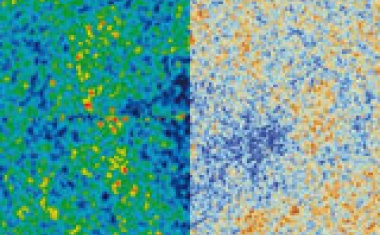
Quantum fluctuations played a crucial role in the formation of the structure of our universe.
On March 21, 2013 something very remarkable happened. The Planck science team released a highly precise photograph of our universe when it was only few hundred thousand years old. This photograph is so detailed that it shows some major features that the universe acquired only 10–35 seconds after creation. Most strikingly, the observed nontrivial features in the portrait of such a young universe came in exact agreement with what had been predicted by the theorists more than thirty years ago, long before the experiment was carried out. Without any exaggeration one can say that by now it is experimentally proven that quantum physics, which is normally considered to be relevant in atomic and smaller scales, also played the crucial role in determining the structure of the whole universe, including the galaxies, stars and planets.
Of course scientists and philosophers have always been interested in the origin of our universe. However, cosmology only became a natural science less than a hundred years ago. It was not until 1923 that the American astronomer Edwin Hubble was able to resolve individual stars in the Andromeda Nebula and to conclude that for sure it is located outside of our own galaxy. This was the beginning of extragalactic astronomy. Today it is well established that there are about a hundred billion galaxies in our universe. Thus, the stars form galaxies with a size of about a hundred thousand light years. Moreover, the distance between neighboring galaxies is a few million light years. Observing the spectral lines of the galaxies, Hubble discovered that they are slightly redshifted. He interpreted this as a Doppler shift due to the relative motion of the other galaxies, which try to escape from us. Hubble also found that the spectral lines of galaxies further away show higher redshift. This means that they are escaping with higher velocities, proportional to the distance (v→ = H r→) and thus the universe expands. This discovery was the beginning of scientific cosmology.
With Hubble’s discovery it became clear that our universe is evolving as a whole. This did not come as a big surprise! In 1922 the Russian physicist Alexander Friedman had found that the generic solutions of the Einstein’s equations describe either an expanding or a contracting Universe. Assuming that the total mass of the universe is about a hundred billion times larger than the mass of our galaxy, Friedman was even able to conclude that the universe must be about 10 billion years old. Thus, Hubble’s discovery can be considered as a brilliant confirmation of the theoretical prediction by Friedman. The most important conclusion from Hubble’s discovery was that the universe was created about several billions years ago. This extremely important discovery remained for many years the single experimentally established fact in cosmology. Only after more than thirty years the other piece of the puzzle was discovered. ...

Neue Technik am La-Silla-Observatorium ergibt visuelle spektrale Daten des heißen Jupiters 51 Pegasi-b.

Mit dem Beitritt Polens zur ESO ist die Finanzierungsschwelle zum Bau des Riesenteleskops E-ELT überschritten.

Polen tritt als neuer Mitgliedstaat der Europäischen Südsternwarte bei.

BMBF fördert insgesamt fünf Forschungsprojekte am Institut für Astrophysik der Uni Göttingen in der Verbundforschung „Erdgebundene Astrophysik und Astroteilchenphysik“.

Erste Sprengung begradigt den Gipfel des Cerro Armazones für den Bau des European Extremely Large Telescope.
Kalibrierung astronomischer Beobachtungsdaten optimiert Datenreduktionspipeline.

Spezielle Infrarot-Schmalbandfilter sollen Atmosphärenrauschen für das Extremely Large Telescope verringern.

Astronomen erstellen Oberflächenkarte und untersuchen die Atmosphäre von Luhman-16A und -16B mit Doppler-Imaging.

Erweiterung des ESO-Hauptsitzes in Garching offiziell eingeweiht – Startschuss von Bauarbeiten für das E-ELT in Chile.

Zwei einsame Gasriesen werfen neues Licht auf die Entstehung von Planeten und Sternen.

Zwei neu entdeckte Himmelskörper ohne Muttersonnen helfen Astronomen beim Verständnis der Sternentstehung.

Vor 50 Jahren wurde das European Southern Observatory ESO gegründet.

Am 5. Oktober 2012 feierte die Europäische Südsternwarte das 50-jährige Jubiläum der Unterzeichnung ihres Gründungsvertrags.

Die ESO wird das größte Teleskop der Welt für sichtbares und infrarotes Licht bauen. Das E-ELT soll Anfang des nächsten Jahrzehnts seinen Betrieb aufnehmen.
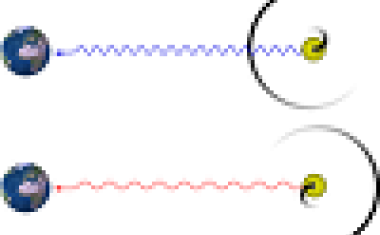
Laser-Frequenzkämme können jetzt als Kalibrationsquellen an astronomischen Spektrographen eingesetzt werden. Dies erleichtert die Suche nach extrasolaren Planeten, die einen Stern außerhalb unseres Sonnensystems umkreisen.
Während drei bis fünf Milliarden Jahre alte Galaxien zu Beginn noch kleine Mahlzeiten aus einem stetigen Zustrom aus Gas bevorzugen, beginnen sie kurz darauf, sich ihre eigenen, kleineren Artgenossen einzuverleiben.

Die Analyse des am Mond reflektierten Lichts der Erde könnte helfen, Exoplaneten besser zu charakterisieren.

Periodische Strukturen in Lichtleitern beseitigen störende Emissionslinien des Nachthimmels.

Mittel für Vorarbeiten an der Straße zum European Extremely Large Telescope und die Entwicklung optischer Komponenten im Eso-Haushaltsplan für 2012 enthalten.

Ein Team europäischer Astronomen hat mithilfe des VLT einen Stern ausfindig gemacht, der nahezu ausschließlich aus Wasserstoff und Helium besteht.

Der größte Staat Südamerikas wird das erste Mitgliedsland der ESO außerhalb Europas sein.

Präzise Geschwindigkeitsmessungen offenbaren Haufen mit hoher Dynamik.

ESO-Council einigt sich auf Standort des geplanten European Extremely Large Telescope mit einem Spiegeldurchmesser von 42 Metern.

Die neuartigen instrumente sind für ein zukünftiges Instrument am "Very Large Telescope" der Europäischen Südsternwarte bestimmt.

Beobachtungen eines scheinbar heimatlosen Schwarzen Lochs deuten auf ein neuartiges Szenario hin, in dem Schwarze Löcher sich die sie umgebenden Galaxien aktiv "zusammenbauen".

Ein neues Auswertungsverfahren für astronomische Bilder im nahen Infrarotbereich erlaubt tiefe Einblicke in das Innere von Centaurus A.

Nach zweijährigem Probelauf hat das Gran Telescopio Canarias am 24. Juli auf der Kanaren-Insel La Palma offiziell seinen Betrieb aufgenommen
Interview zum russischen Vakuumbomben-Test