Suchen nach: "Extremely Large Telescope"
 Jakob Schöll • 10/2026 • Seite 40 • DPG-Mitglieder
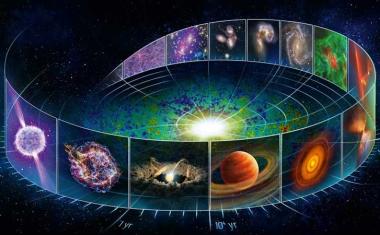
Von Sekunden bis Jahrmilliarden
Der Exzellenzcluster „Unser dynamisches Universum“ erforscht die Evolution
des Universums auf allen Zeitskalen.
Sekundenschnelle Fast Radio Bursts oder Supernovae sind für die Dynamik des Universums ebenso wichtig wie die Sternentstehung, die mehrere Millionen Jahre in Anspruch nimmt, oder die Entwicklung der Galaxien über Milliarden von Jahren hinweg. Das Ziel des Exzellenzclusters „Unser dynamisches Universum“ (Dynaverse) ist es zu untersuchen, wie sich die Ereignisse auf kurzen Zeitskalen und die langfristigen Prozesse gegenseitig beeinflussen, um die Dynamik des Universums besser zu verstehen. Dafür vereint der Cluster Expertise für Instrumentenentwicklung, Beobachtungen, Simulationen, Laborastrophysik und Astroinformatik.
Dynaverse ist eine Kooperation zwischen der Universität zu Köln, der Universität Bonn, dem Max-Planck-Institut für Radioastronomie und weiteren Institutionen (Infokasten). Die beiden Universitäten arbeiten in der Astronomie bereits seit vielen Jahren eng zusammen, unter anderem im Rahmen von Sonderforschungsbereichen. Zu den gemeinsamen Projekten zählen zudem der Bau und Betrieb des Fred Young Submillimeter Telescope in Chile zusammen mit internationalen Partnern.
Die Forschung im Cluster fokussiert sich auf drei „Astrophysical Research Challenges“. Die erste beschäftigt sich mit der Zeitraffer-Astronomie, also mit Phänomenen im Universum, die auf so langen Zeitskalen stattfinden, dass sie sich nicht in Echtzeit verfolgen lassen. Dazu gehören die Galaxienentwicklung sowie die Stern- und Planetenentstehung und der damit verbundene Transport von Staub und Gas über viele Skalen hinweg.
In der Zweiten geht es um die Zeitlupen-Astronomie, die sich auf kurzzeitige, also transiente Ereignisse wie Supernovae, Radioblitze oder die Verschmelzung von Schwarzen Löchern konzentriert. Diese meist sehr energiereichen Phänomene können ganze Galaxien beeinflussen, was eine Verbindung zur ersten Research Challenge herstellt. Um Wechselwirkungen zwischen transienten Ereignissen und den Entwicklungen auf langen Zeitskalen genau zu verstehen, sind neben detaillierteren Beobachtungen auch umfangreiche Simulationen notwendig, welche die unterschiedlichen Skalen miteinander koppeln.
Die dritte Research Challenge zielt auf „Cosmic Twists“ ab, also Wendepunkte in der Evolution des Kosmos, die einmalig auftreten und das gesamte Universum für immer verändern. Dazu zählen die kosmische Inflation, also die exponentielle Expansion des Universums direkt nach dem Urknall, die Phase der Reionisation kurz nach der Entstehung der ersten Sterne und Galaxien und der Zeitpunkt, seit dem die Dunkle Energie über die sichtbare und Dunkle Materie dominiert. (...)
Matthias Delbrück • 6/2026 • Seite 13 • DPG-Mitglieder
USA: PCAST besetzt, NSB gefeuert; Gemeinsame Sorgen; Fusion im DOE
Thomas Willemsen, Melanie Gauch, Tobias Groß, Henrik Ehlers, and Wolfgang Ebert • 1/2026 • Seite 9Advanced coated optics for high-energy laser systems
Complex sputtered dielectric coatings enable high LIDT, low losses, and dispersion control for apertures up to 550 mm.
Martin Enderlein and Frank Lison • 1/2026 • Seite 36AKL´26: Revolutionizing astronomy and beyond
TOPTICA’s high-power sodium guide star lasers push the frontiers of adaptive optics
Matthias Delbrück, • 3/2026 • Seite 16 • DPG-Mitglieder
USA: Schmidt-Teleskope neuer Art; Kongress kürzt Kürzungen; Mars macht nicht mobil; Abgänge mit Ph.D.
Kerstin Sonnabend • 1/2026 • Seite 15 • DPG-MitgliederSchutz für den Nachthimmel
Mit einem Offenen Brief fordern Nobelpreisträger Reinhard Genzel und weitere Astronom:innen dazu auf, den Nachthimmel über dem Paranal-Observatorium der ESO zu schützen.
Kerstin Sonnabend • 1/2026 • Seite 15 • DPG-Mitglieder
Die Kunst des Lichts
Matthias Delbrück • 4/2025 • Seite 12 • DPG-MitgliederDiplomatie durch und für die Wissenschaft
Zwei Initiativen wollen die Position der Wissenschaft in der Weltpolitik stärken.
Anja Hauck / MPG • 4/2025 • Seite 12 • DPG-Mitglieder
Bundespräsident in Chile
Kerstin Sonnabend • 11/2024 • Seite 10 • DPG-Mitglieder
Aus dem Bahnhof in die Ausstellung
 Isabelle Kleiner • 9/2024 • Seite 63 • DPG-Mitglieder
Spectroscopy of molecules
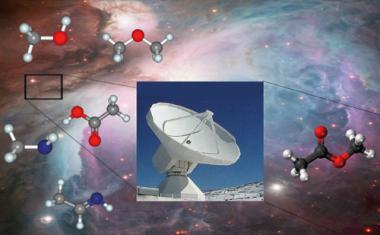
The study of molecules with large amplitude motions takes us on a journey from molecular structure to astrophysics.
Spectroscopy allows us to use light to explore, detect and quantify molecules in the interstellar medium, in the atmospheres of planets and exoplanets, in comets, stars, and so on. Spectroscopy also makes it possible to determine the three-dimensional structure of complex molecules and of molecules that form the building blocks of biological molecules (biomimetics). Gas phase spectroscopy gives information about intramolecular dynamics occurring in molecules.
Internal rotors are molecules containing an atom or a group of atoms that can rotate through a torsional angle α relative to the other parts of the molecule. This motion is hindered by a potential barrier, so the internal rotation is not “free” (Fig. 1). Internal rotation or torsion is called Large Amplitude Motion (LAM) because the internally rotating group of atoms moves far away from equilibrium positions compared to the bond lengths.
V(α) is the internal rotation potential function (Fig. 1), which has a 2π/3 periodicity for a methyl rotor top (–CH3). It can be expressed in the following Fourier series in terms of the torsional angle α, the leading term V3 is called the height of the barrier [1, 2]: (...)
Matthias Delbrück • 4/2024 • Seite 13 • DPG-Mitglieder
USA: Keine Lieferung vom Mars?; Doch nur ein Teleskop; Mehr Chips produzieren
Kerstin Sonnabend • 10/2023 • Seite 12 • DPG-MitgliederKritik am Verhaltenskodex
Eine Überarbeitung des Verhaltenskodex der IAU stößt nicht nur auf Gegenliebe.
BMBF / Anja Hauck • 10/2023 • Seite 13 • DPG-Mitglieder
Fusionsforschung fördern
Matthias Delbrück • 10/2023 • Seite 13 • DPG-MitgliederZu viel politischer Einfluss
Indien investiert einen Milliardenbetrag in seine neue Agentur für Grundlagen- und angewandte Forschung.
Michael Schlüter, TU Hamburg • 7/2023 • Seite 12 • DPG-Mitglieder
DFG: Neue Sonderforschungsbereiche
Maike Pfalz • 6/2023 • Seite 6 • DPG-MitgliederVisionäre Astronomie
Astronet hat einen strategischen Plan für die europäische Astronomie für die Jahre 2022 bis 2035 vorgelegt.
Anja Hauck • 6/2023 • Seite 7 • DPG-MitgliederEin Haus für Einstein
Die Planungen für das Einstein Discovery Center in Ulm werden konkreter.
Kerstin Sonnabend • 1/2023 • Seite 10 • DPG-Mitglieder
Förderung für sieben Jahre gesichert
Matthias Delbrück • 11/2022 • Seite 16 • DPG-Mitglieder
USA: Wo das Geld hingeht
Alexander Pawlak • 11/2022 • Seite 15 • DPG-Mitglieder
Proteste im Iran
Ralph Delmdahl, Ulrich Emmerichs, Thomas Trickl, and Hannes Vogelmann • 1/2019 • Seite 8
Taking measurements to the top
Kerstin Sonnabend • 1/2021 • Seite 14 • DPG-MitgliederPräzise Daten für die Navigation
In Südafrika haben astrometrische Beobachtungen seit 200 Jahren Tradition.
Kerstin Sonnabend • 10/2020 • Seite 13 • DPG-Mitglieder
Knapp am Ziel vorbei
Kerstin Sonnabend • 10/2020 • Seite 13 • DPG-Mitglieder
USA
Alexander Pawlak • 10/2020 • Seite 12 • DPG-Mitglieder
Gestörter Sternenhimmel
Matthias Delbrück • 7/2020 • Seite 8 • DPG-MitgliederStrategische Strukturen
Das europäische Strategieforum äußert sich zur Entwicklung der europäischen Forschungsinfrastrukturen.
Matthias Delbrück • 7/2020 • Seite 8 • DPG-MitgliederVerteilte Begutachtung
Das European Southern Observatory hat ein neues Verfahren getestet, um Beobachtungszeiten zuzuweisen.
Alexander Pawlak • 11/2019 • Seite 13
Künstliche Intelligenz für die Grundlagenforschung
1/2018 • Seite 1Optik&Photonik 1
Cover Picture
Free Access
- First Published: 09 February 2018
Editorial
Free Access
- Pages: 1
- First Published: 09 February 2018
Contents
Free Access
- Pages: 2-3
- First Published: 09 February 2018
News
Free Access
- Pages: 4-7
- First Published: 09 February 2018
Products
Free Access
- Pages: 8-9
- First Published: 09 February 2018
Special Section W3+ Fair
Free Access
- Pages: 10
- First Published: 09 February 2018
Free Access
- Pages: 11
- First Published: 09 February 2018
Free Access
- Pages: 12-13
- First Published: 09 February 2018
Free Access
- Pages: 14-18
- First Published: 09 February 2018
Organizations & Initiatives
Free Access
- Pages: 19
- First Published: 09 February 2018
Market Report
Free Access
- Pages: 20-24
- First Published: 09 February 2018
Preview
Free Access
- Pages: 24
- First Published: 09 February 2018
Measurement Technology
Free Access
- Pages: 25-27
- First Published: 09 February 2018
Biophotonics
Free Access
- Pages: 28-31
- First Published: 09 February 2018
Free Access
- Pages: 32-35
- First Published: 09 February 2018
Microscopy
Free Access
- Pages: 36-39
- First Published: 09 February 2018
Preview
Free Access
- Pages: 39
- First Published: 09 February 2018
Measurement Technology
Free Access
- Pages: 40-43
- First Published: 09 February 2018
Displays
Free Access
- Pages: 44-47
- First Published: 09 February 2018
Optical Systems
Free Access
- Pages: 48-51
- First Published: 09 February 2018
Calendar
Free Access
- Pages: 52
- First Published: 09 February 2018
Meetings
Free Access
- Pages: 53-55
- First Published: 09 February 2018
Service
Free Access
- Pages: 56
- First Published: 09 February 2018
Index & Masthead
Free Access
- Pages: 57
- First Published: 09 February 2018
 Yiannis Tsapras, Markus Hundertmark und Joachim Wambsganß • 4/2018 • Seite 18
Das wohltemperierte Revier
Neue Messungen und Analysen weisen auf eine felsige Struktur bei den Planeten des Sterns Trappist-1 hin. Die erdähnlichen Planeten könnten Atmosphären sowie flüssiges Wasser auf ihrer Oberfläche besitzen.
Anja Hauck / ESO • 1/2018 • Seite 12
Auf der Jagd nach Planeten
 Jörg Wrachtrup • 9/2017 • Seite 22
Die Mischung macht‘s
Eine Methode der klassischen Signalverarbeitung hilft, Quantensensoren zu verbessern.
 Alexander Pawlak • 7/2017 • Seite 6
Hoffnungsschimmer am Radiohimmel
Kerstin Sonnabend / ESO • 7/2017 • Seite 7
Extrem viel gemeistert
Alexander Pawlak • 7/2016 • Seite 6
Astronomen machen großes Auge
Matthias Delbrück • 4/2016 • Seite 10
ERC: Frauen mit besserer Erfolgsquote
Maike Pfalz • 4/2016 • Seite 10
ESFRI: Sonne, Wolken, Neutrinos
 Viatcheslav F. Mukhanov • 9/2015 • Seite 41
The Quantum Universe
Quantum fluctuations played a crucial role in the formation of the structure of our universe.
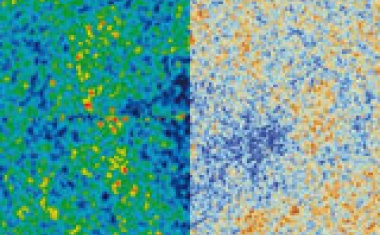
On March 21, 2013 something very remarkable happened. The Planck science team released a highly precise photograph of our universe when it was only few hundred thousand years old. This photograph is so detailed that it shows some major features that the universe acquired only 10–35 seconds after creation. Most strikingly, the observed nontrivial features in the portrait of such a young universe came in exact agreement with what had been predicted by the theorists more than thirty years ago, long before the experiment was carried out. Without any exaggeration one can say that by now it is experimentally proven that quantum physics, which is normally considered to be relevant in atomic and smaller scales, also played the crucial role in determining the structure of the whole universe, including the galaxies, stars and planets.
Of course scientists and philosophers have always been interested in the origin of our universe. However, cosmology only became a natural science less than a hundred years ago. It was not until 1923 that the American astronomer Edwin Hubble was able to resolve individual stars in the Andromeda Nebula and to conclude that for sure it is located outside of our own galaxy. This was the beginning of extragalactic astronomy. Today it is well established that there are about a hundred billion galaxies in our universe. Thus, the stars form galaxies with a size of about a hundred thousand light years. Moreover, the distance between neighboring galaxies is a few million light years. Observing the spectral lines of the galaxies, Hubble discovered that they are slightly redshifted. He interpreted this as a Doppler shift due to the relative motion of the other galaxies, which try to escape from us. Hubble also found that the spectral lines of galaxies further away show higher redshift. This means that they are escaping with higher velocities, proportional to the distance (v→ = H r→) and thus the universe expands. This discovery was the beginning of scientific cosmology.
With Hubble’s discovery it became clear that our universe is evolving as a whole. This did not come as a big surprise! In 1922 the Russian physicist Alexander Friedman had found that the generic solutions of the Einstein’s equations describe either an expanding or a contracting Universe. Assuming that the total mass of the universe is about a hundred billion times larger than the mass of our galaxy, Friedman was even able to conclude that the universe must be about 10 billion years old. Thus, Hubble’s discovery can be considered as a brilliant confirmation of the theoretical prediction by Friedman. The most important conclusion from Hubble’s discovery was that the universe was created about several billions years ago. This extremely important discovery remained for many years the single experimentally established fact in cosmology. Only after more than thirty years the other piece of the puzzle was discovered. ...
 Alexander Pawlak • 1/2015 • Seite 7
Grünes Licht für E-ELT
 Maike Pfalz • 1/2015 • Seite 6
Neue Struktur der Materie
Katja Paff • 12/2013 • Seite 6
Die Chancen der Chancengleichheit
Alexander Pawlak • 1/2013 • Seite 7
Promotion im Profil
1/2013 • Seite 8
DFG: Neue SFBs
Stefan Jorda • 11/2012 • Seite 7
ESO: Die Zukunft der Astronomie
 Maike Pfalz • 1/2012 • Seite 6
ITER: Hürde aus dem Weg geräumt
Alexander Pawlak • 3/2011 • Seite 6
Chemie für alle
Oliver Dreissigacker • 3/2011 • Seite 7
Brasiliens Beitritt stärkt die ESO
Oliver Dreissigacker • 6/2010 • Seite 6
E-ELT: Groß - größer - extrem groß!
Alexander Kann • 9/2009 • Seite 118
Schilling, G. und Christensen, L. L.: Unser Fenster zum Weltraum
9/2009 • Seite 12
TV-Tipps
Sonja Franke-Arnold • 9/2009 • Seite 12
Großbritannien: Visionen unter Geldnot
Maike Pfalz • 9/2009 • Seite 11
Grantecan: Über den Wolken
Martin Geller und Axel Lorke • 9/2009 • Seite 118
Lüth, H.: Quantenphysik in der Nanowelt
Stefan Jorda • 2/2009 • Seite 7
FRM II: Nicht zu schaffen
Alexander Pawlak • 2/2009 • Seite 6
Astronomische Ausgaben
Alexander Pawlak • 11/2007 • Seite 12
Wunschzettel für den Weltraum
Stefan Jorda • 11/2007 • Seite 11''Russland möchte zeigen, dass es mit den USA mithalten kann''
Interview zum russischen Vakuumbomben-Test
Stefan Jorda • 12/2006 • Seite 7
Europäische Wunschliste für Großprojekte
Werner Aeschbach-Hertig, Ulrich Platt und Wolfgang Roether • 3/2006 • Seite 68
Physics of the EnvironmentWEH-Sommerschule
Klaus R. Schubert • 3/2006 • Seite 67
Flavour Physics and CP ViolationWEH-Sommerschule
Sebastian Wolf, Thomas Henning, Wilhelm Kley und Joachim Wambsganss • 3/2006 • Seite 68
Extrasolar Planetary SystemsWEH-Physikschule
2/2006 • Seite 1Februar
Rund 100 Meter unter der Erde wird derzeit der 7000 Tonnen schwere ATLAS-Detektor, eines der zentralen Experimente des Large Hadron Colliders am CERN, zusammengebaut (vgl. S. 29. Quelle: CERN).