
Additive manufacturing reaches new heights
UpNano and SmarAct combine high-end optics and high-end motion
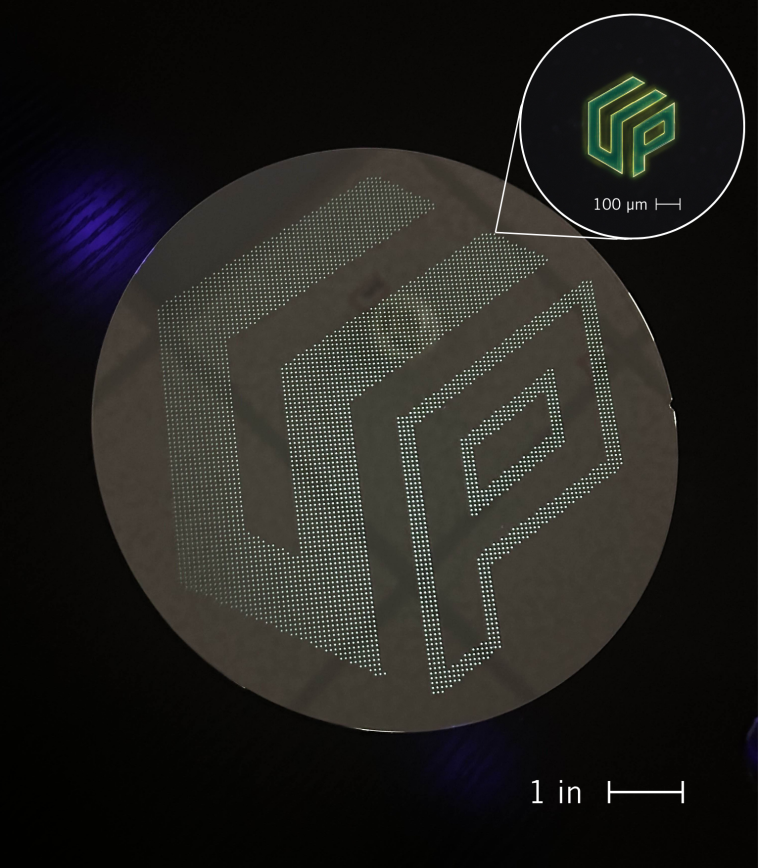
3D printing has come of age – from the workbench to high-tech industry. With the help of two-photon polymerization, this technology has reached a new dimension: UpNano’s NanoPro VT combines adaptive voxel size for maximum printing speed with high-precision motion technology from SmarAct. The result: structures in the nanometer range, manufactured faster and more precisely than ever before.
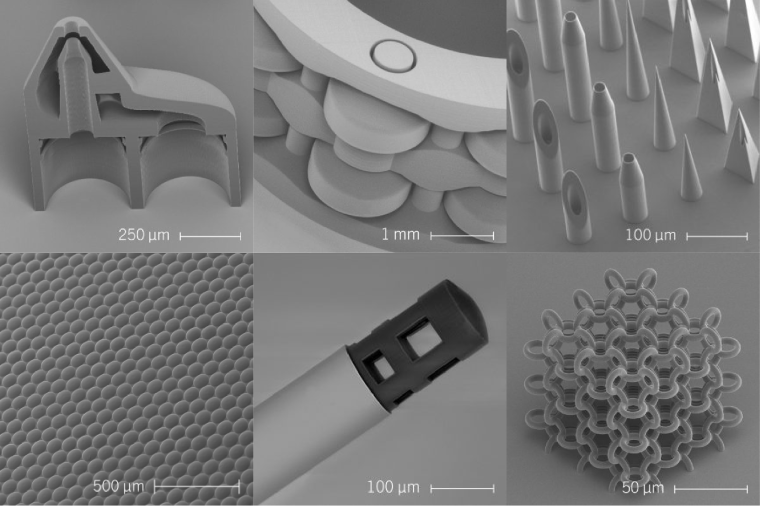
3 D printing has evolved from a niche innovation to a driving force behind the manufacturing revolution – disruptive, versatile, and limitless in its applications. While entire houses are already being built layer by layer on a large scale, high-precision additive manufacturing in the nanometer range – for example, through two-photon polymerization (2PP) – is opening up completely new possibilities for science and industry. Here, material innovation and precision merge to create structures that set new standards even under the microscope.
Two-photon polymerization belongs to the family of stereolithography (SLA) methods: The raw material is in liquid form as a resin and is cured by absorption of optical radiation. The optics define how large the smallest volume elements – voxels – can be. As the name suggests, 2PP requires two photons for the polymerization reaction. Since the simultaneous absorption of two photons is an extremely rare event, this only happens in a small area of the focus with a particularly high energy density. This allows voxel sizes of less than 100 nanometers to be achieved.
However, the voxel size has a huge impact on printing time: typical laser sources for 2PP have repetition rates of up to 100 MHz. With a voxel size of 1 µm, this means it takes just under three hours to fill one cubic centimeter. If the voxel size is reduced to 100 nm, it takes almost four months to fill the same volume – which is not really worth it. To speed up the process, manufacturers’ creativity knows no bounds; often, the size or shape of the voxel is adjusted in one way or another. With its patented “adaptive resolution” method, the Vienna-based high-tech company UpNano has reduced the printing time of a structure from an original 16 days to 2.5 hours on its NanoOne tabletop device.
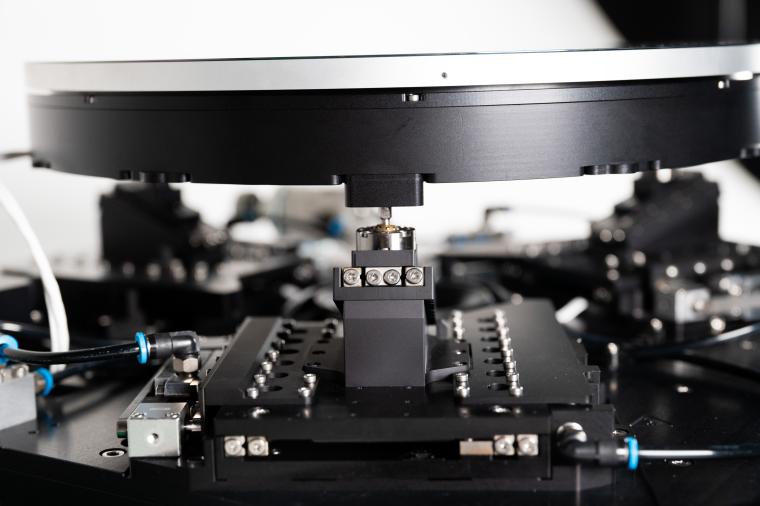
With the NanoPro VT platform – for voxel tuning – the company is setting new standards.The variability of the voxel size is significantly increased by using a lens changer: a high-resolution lens can be used for the finest contours and switched to a lower magnification for “volume work.” This reduces the printing time for the same component by a further factor of 10.
Microscope lenses with high magnification are used for printing. Because they can reproduce an enormous level of detail, they have a very small working field. To cover the largest possible printing area, the optics or components must be moved. This places high demands on the motion technology – after all, the nanometer-scale resolution enabled by 2PP should not be negated by a repeat accuracy of a few micrometers.
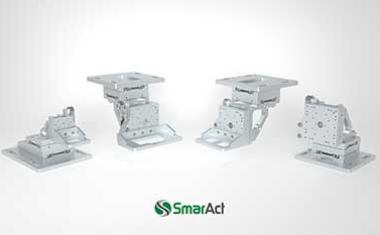
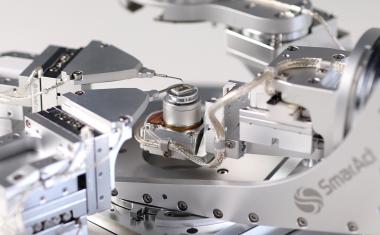
On the micrometer and submicrometer scale, every small irregularity on the print bed, every slight deflection, every scratch counts. UpNano has a strong partner for this in the Oldenburg-based high-tech company SmarAct: a five-axis system developed in-house by SmarAct enables high-precision movement in the plane and allows the print bed to be tilted slightly and varied in height to compensate for the smallest unevenness.
Changing lenses also requires maximum precision in movement. The optics must focus quickly and accurately – repeatable within a range of a few tens of nanometers. Here, too, SmarAct provides a comprehensive solution that covers several other movement tasks in the machine in addition to this one.
UpNano GmbH
Modecenterstr. 22/D36
1030 Vienna
Austria
phone: +43 (0) 1 890-1652
e-mail: office@upnano.com
Website: www.upnano.com