

Suchen nach: "Extremely Large Telescope"
• 1/2026 • Seite 36
AKL´26: Revolutionizing astronomy and beyond
TOPTICA’s high-power sodium guide star lasers push the frontiers of adaptive optics
• 1/2026 • Seite 9
Advanced coated optics for high-energy laser systems
Complex sputtered dielectric coatings enable high LIDT, low losses, and dispersion control for apertures up to 550 mm.
• 3/2026 • Seite 16 • DPG-Mitglieder
USA: Schmidt-Teleskope neuer Art; Kongress kürzt Kürzungen; Mars macht nicht mobil; Abgänge mit Ph.D.
• 1/2026 • Seite 15 • DPG-Mitglieder
Schutz für den Nachthimmel
Mit einem Offenen Brief fordern Nobelpreisträger Reinhard Genzel und weitere Astronom:innen dazu auf, den Nachthimmel über dem Paranal-Observatorium der ESO zu schützen.
• 4/2025 • Seite 12 • DPG-Mitglieder
Diplomatie durch und für die Wissenschaft
Zwei Initiativen wollen die Position der Wissenschaft in der Weltpolitik stärken.
 • 9/2024 • Seite 63 • DPG-Mitglieder
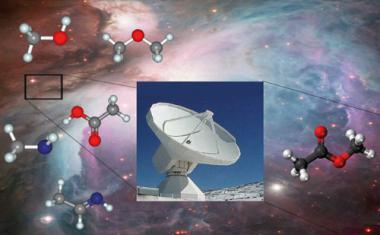
Spectroscopy of molecules
The study of molecules with large amplitude motions takes us on a journey from molecular structure to astrophysics.
Spectroscopy allows us to use light to explore, detect and quantify molecules in the interstellar medium, in the atmospheres of planets and exoplanets, in comets, stars, and so on. Spectroscopy also makes it possible to determine the three-dimensional structure of complex molecules and of molecules that form the building blocks of biological molecules (biomimetics). Gas phase spectroscopy gives information about intramolecular dynamics occurring in molecules.
Internal rotors are molecules containing an atom or a group of atoms that can rotate through a torsional angle α relative to the other parts of the molecule. This motion is hindered by a potential barrier, so the internal rotation is not “free” (Fig. 1). Internal rotation or torsion is called Large Amplitude Motion (LAM) because the internally rotating group of atoms moves far away from equilibrium positions compared to the bond lengths.
V(α) is the internal rotation potential function (Fig. 1), which has a 2π/3 periodicity for a methyl rotor top (–CH3). It can be expressed in the following Fourier series in terms of the torsional angle α, the leading term V3 is called the height of the barrier [1, 2]: (...)
• 4/2024 • Seite 13 • DPG-Mitglieder
USA: Keine Lieferung vom Mars?; Doch nur ein Teleskop; Mehr Chips produzieren
• 10/2023 • Seite 12 • DPG-Mitglieder
Kritik am Verhaltenskodex
Eine Überarbeitung des Verhaltenskodex der IAU stößt nicht nur auf Gegenliebe.
• 10/2023 • Seite 13 • DPG-Mitglieder
Zu viel politischer Einfluss
Indien investiert einen Milliardenbetrag in seine neue Agentur für Grundlagen- und angewandte Forschung.
• 6/2023 • Seite 6 • DPG-Mitglieder
Visionäre Astronomie
Astronet hat einen strategischen Plan für die europäische Astronomie für die Jahre 2022 bis 2035 vorgelegt.
• 6/2023 • Seite 7 • DPG-Mitglieder
Ein Haus für Einstein
Die Planungen für das Einstein Discovery Center in Ulm werden konkreter.
• 1/2021 • Seite 14 • DPG-Mitglieder
Präzise Daten für die Navigation
In Südafrika haben astrometrische Beobachtungen seit 200 Jahren Tradition.
• 7/2020 • Seite 8 • DPG-Mitglieder
Verteilte Begutachtung
Das European Southern Observatory hat ein neues Verfahren getestet, um Beobachtungszeiten zuzuweisen.
• 7/2020 • Seite 8 • DPG-Mitglieder
Strategische Strukturen
Das europäische Strategieforum äußert sich zur Entwicklung der europäischen Forschungsinfrastrukturen.
1/2018 • Seite 1weiterlesen
Optik&Photonik 1
Cover Picture
Free Access
Cover Picture: Optik & Photonik 1/2018
- First Published: 09 February 2018
Editorial
Free Access
Photonics Is International: W3+ Fair paying tribute to cross‐border collaborations – EPIC new gold sponsor
- Pages: 1
- First Published: 09 February 2018
Contents
Free Access
Contents: Optik & Photonik 1/2018
- Pages: 2-3
- First Published: 09 February 2018
News
Free Access
News: Optik & Photonik 1/2018
- Pages: 4-7
- First Published: 09 February 2018
Products
Free Access
Products: Optik & Photonik 1/2018
- Pages: 8-9
- First Published: 09 February 2018
Special Section W3+ Fair
Free Access
Editorial
- Pages: 10
- First Published: 09 February 2018
Free Access
ELI: Wetzlar Inside
- Pages: 11
- First Published: 09 February 2018
Free Access
Three Business Cases
- Pages: 12-13
- First Published: 09 February 2018
Free Access
Oil‐Repellent Optics for Wastewater Sensor Applications: A systematic combination of nano‐roughness and adapted coatings
- Thomas Oberbillig
- Nadja Felde
- Martin Franz
- Luisa Coriand
- Nancy Dahms
- Karin Munderloh
- Karin Schultz
- Michael Fliedner
- Angela Duparré
- Pages: 14-18
- First Published: 09 February 2018
Organizations & Initiatives
Free Access
Organizations & Initiatives: Optik & Photonik 1/2018
- Pages: 19
- First Published: 09 February 2018
Market Report
Free Access
Industrial Cameras, Technical Features, and Market: Imaging is becoming a fundamental building block of the digitally networked world and is contributing to greater efficiency, security and comfort in every area of life
- Pages: 20-24
- First Published: 09 February 2018
Preview
Free Access
New Process Chain for the Production of Complex Freeform Optical Components: Efficient manufacturing approaches for fabrication of 3D glass parts
- Pages: 24
- First Published: 09 February 2018
Measurement Technology
Free Access
Non‐Contact Measurement Brings Decisive Optimization: How non‐contact center thickness measurement of lenses can improve production flow
- Pages: 25-27
- First Published: 09 February 2018
Biophotonics
Free Access
Towards a Fully Integrated Lab‐On‐A‐Chip: Flexible opto‐fluidic platform for fluorescence and microarray‐based molecular diagnostics at the point of care
- Pages: 28-31
- First Published: 09 February 2018
Free Access
No More Sunburn: Non‐invasive LED‐based measurement of the sun protection factor
- Pages: 32-35
- First Published: 09 February 2018
Microscopy
Free Access
Mobile Microscopy and Automated Image Analysis: The ease of cell counting and classification
- Pages: 36-39
- First Published: 09 February 2018
Preview
Free Access
Multiphoton Tomography for In Vivo Skin‐Age Determination: Dermal autofluorescence and second harmonic generation allow non‐invasive imaging of biological tissue
- Pages: 39
- First Published: 09 February 2018
Measurement Technology
Free Access
Optical Metrology of Freeforms and Complex Lenses: 3D form measurements of precision optical surfaces based on scanning point interferometry
- Pages: 40-43
- First Published: 09 February 2018
Displays
Free Access
Microdisplays for Smart Eyewear: OLED‐on‐silicon technology is the key for displays with high performance and low power consumption
- Pages: 44-47
- First Published: 09 February 2018
Optical Systems
Free Access
The Largest Eye That Humankind Has Cast into the Heavens: Drive technology for the Extremely Large Telescope
- Pages: 48-51
- First Published: 09 February 2018
Calendar
Free Access
Events February 2018 – May 2018
- Pages: 52
- First Published: 09 February 2018
Meetings
Free Access
Meetings: Optik & Photonik 1/2018
- Pages: 53-55
- First Published: 09 February 2018
Service
Free Access
Buyers' Guide
- Pages: 56
- First Published: 09 February 2018
Index & Masthead
Free Access
Company Index
- Pages: 57
- First Published: 09 February 2018
 • 4/2018 • Seite 18
Das wohltemperierte Revier
Neue Messungen und Analysen weisen auf eine felsige Struktur bei den Planeten des Sterns Trappist-1 hin. Die erdähnlichen Planeten könnten Atmosphären sowie flüssiges Wasser auf ihrer Oberfläche besitzen.
 • 9/2017 • Seite 22
Die Mischung macht‘s
Eine Methode der klassischen Signalverarbeitung hilft, Quantensensoren zu verbessern.
 • 9/2015 • Seite 41
The Quantum Universe
Quantum fluctuations played a crucial role in the formation of the structure of our universe.
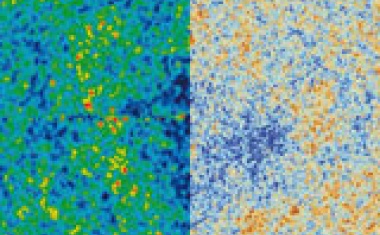
On March 21, 2013 something very remarkable happened. The Planck science team released a highly precise photograph of our universe when it was only few hundred thousand years old. This photograph is so detailed that it shows some major features that the universe acquired only 10–35 seconds after creation. Most strikingly, the observed nontrivial features in the portrait of such a young universe came in exact agreement with what had been predicted by the theorists more than thirty years ago, long before the experiment was carried out. Without any exaggeration one can say that by now it is experimentally proven that quantum physics, which is normally considered to be relevant in atomic and smaller scales, also played the crucial role in determining the structure of the whole universe, including the galaxies, stars and planets.
Of course scientists and philosophers have always been interested in the origin of our universe. However, cosmology only became a natural science less than a hundred years ago. It was not until 1923 that the American astronomer Edwin Hubble was able to resolve individual stars in the Andromeda Nebula and to conclude that for sure it is located outside of our own galaxy. This was the beginning of extragalactic astronomy. Today it is well established that there are about a hundred billion galaxies in our universe. Thus, the stars form galaxies with a size of about a hundred thousand light years. Moreover, the distance between neighboring galaxies is a few million light years. Observing the spectral lines of the galaxies, Hubble discovered that they are slightly redshifted. He interpreted this as a Doppler shift due to the relative motion of the other galaxies, which try to escape from us. Hubble also found that the spectral lines of galaxies further away show higher redshift. This means that they are escaping with higher velocities, proportional to the distance (v→ = H r→) and thus the universe expands. This discovery was the beginning of scientific cosmology.
With Hubble’s discovery it became clear that our universe is evolving as a whole. This did not come as a big surprise! In 1922 the Russian physicist Alexander Friedman had found that the generic solutions of the Einstein’s equations describe either an expanding or a contracting Universe. Assuming that the total mass of the universe is about a hundred billion times larger than the mass of our galaxy, Friedman was even able to conclude that the universe must be about 10 billion years old. Thus, Hubble’s discovery can be considered as a brilliant confirmation of the theoretical prediction by Friedman. The most important conclusion from Hubble’s discovery was that the universe was created about several billions years ago. This extremely important discovery remained for many years the single experimentally established fact in cosmology. Only after more than thirty years the other piece of the puzzle was discovered. ...

• 11/2007 • Seite 11
''Russland möchte zeigen, dass es mit den USA mithalten kann''
Interview zum russischen Vakuumbomben-Test