

Optische Tricks mit chiralem Dreh
Asymmetrische Moleküle - d. h. Moleküle mit Händigkeit - verursachen „Doppelreflexion“ und „Doppelfluoreszenz“.

Asymmetrische Moleküle - d. h. Moleküle mit Händigkeit - verursachen „Doppelreflexion“ und „Doppelfluoreszenz“.
 • 9/2024 • Seite 76 • DPG-Mitglieder
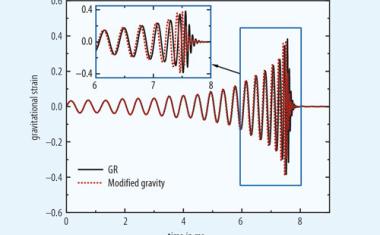
Gravitational waves promise to shed light on fundamental physics through observations of dark compact objects.
Gravitational waves provide a unique window into the most cataclysmic events in the universe, from the Big Bang to black hole mergers. They complement traditional electromagnetic astronomy and, in addition, reveal phenomena that were previously hidden from our view.
The direct detection of gravitational waves in 2015 [1] was among the most important discoveries in fundamental physics in recent decades and a proof of one of the fundamental predictions of General Relativity (GR). The signal was observed by the two underground LIGO detectors in Hanford and in Livingston (Fig. 1); the comparison of the data in the bottom plot demonstrates that both detectors witnessed the same event. At least two detectors operating simultaneously are needed to confirm the detection because these instruments are so sensitive that various noises might contaminate the signal, such as seismic activities or even animals walking on the ground above the detector. In addition, it is very important that the observed signal matches the theoretical prediction very well. This is a confirmation that the observed gravitational wave event is a merger of two compact objects with spacetime curvature in their vicinity reaching extreme values. Even though a number of exotic scenarios cannot be excluded, the most probable one is that these were two colliding black holes. (...)
 • 9/2020 • Seite 32 • DPG-Mitglieder
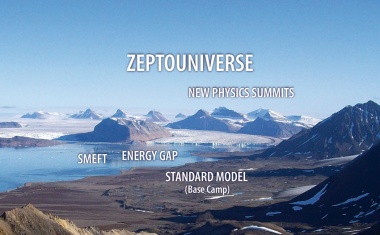
Flavour experiments promise insights into energy scales as high as 200 TeV and distances as small as 10−21 meter and offer the chance to identify New Physics.
The Large Hadron Collider (LHC) at CERN will directly probe distance scales as short as 10–19 m, corresponding to energy scales at the level of a few TeV. Presently, higher resolution can only be achieved with the help of quantum fluctuations caused by new particles and new forces that act at very short distance scales and modify the predictions of the Standard Model of particle physics for very rare processes. In this context, weak decays of mesons and leptons play the prominent role besides the transitions between particles and antiparticles in which flavours of quarks and leptons are changed. In this manner, information about the Zeptouniverse corresponding to energy scales as high as 200 TeV or distances as small as 10–21 m can be obtained.
The year 1676 was very important for humanity, because Antoni van Leeuwenhoek discovered the empire of bacteria. He called these small creatures animalcula (small animals). His discovery was a milestone in our civilization for at least two reasons: He discovered creatures invisible to us which have been killing humans for thousands of years, often responsible for millions of deaths in one year. While Antoni van Leeuwenhoek did not know that bacteria could be dangerous for humans, his followers like Louis Pasteur, Robert Koch and other „microbe hunters“ realized the danger coming from these tiny creatures and also developed weapons against this empire [1].
Van Leeuwenhoek was the first human who looked at short distance scales invisible to us and discovered thereby a new underground world. At that time, researchers looked mainly at large distances, discovering new planets and finding laws, such as the Kepler laws which Isaac Newton was able to derive from his mechanics. (...)
 • 9/2020 • Seite 51 • DPG-Mitglieder
How to study Dark Matter from high-energy collisions and what is known so far.
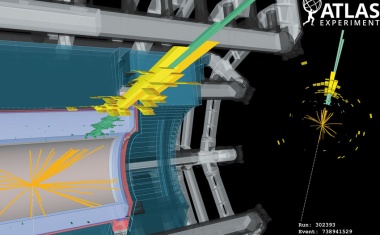
In the last century, high-energy physics has made incredible steps forward towards the comprehension of the nature of our universe, its matter content and interactions. This development culminated with the discovery of a Higgs boson by the Large Hadron Collider experiments completing the last piece of the particle puzzle. Nevertheless, the Standard Model of particle physics cannot explain the existence of Dark Matter yet. Uncovering the identity of this kind of matter is a central and grand challenge for both fundamental physics and astronomy.
The nature and properties of Dark Matter are largely unknown: proposed candidates span tens of orders of magnitude in mass, ranging from elementary particles infinitesimally lighter than electrons to massive primordial black holes [1]. One of the most compelling candidates is a new class of subatomic particles: weakly interacting massive particles (WIMPs). WIMPs represent the current paradigm for searches for Dark Matter particles. They are up to a hundred times heavier than protons and only interact weakly with ordinary particles. Presumably, they were produced in the early universe.
To understand Dark Matter is a multi-disciplinary effort involving different and complementary experimental techniques. Direct searches rely on the distribution of Dark Matter in the Milky Way exposing the Earth to a constant high flux of Dark Matter particles. Direct detection experiments aim to detect their elastic scattering off nuclei in specialised low background detectors. Indirect searches are based on the annihilations or decays of Dark Matter particles in astrophysical systems. Various ground and space-based specialised instruments monitor the frequency of such events. Collisions in high-energy particle accelerators like the Large Hadron Collider (LHC) might create particles which were present in the early universe. (...)
 • 9/2014 • Seite 37
Life as a problem in nonequilibrium statistical mechanics
We review some problems in nonequilibrium physics from the point of view of statistical physics and differentiable dynamics. Specifically, we discuss the mathematical difficulties which inherently underlie applications to heat transport, to hydrodynamic turbulence, and to the study of life. The microscopic dynamics of transport phenomena (in particular heat transport) is necessarily non hyperbolic, which explains why it is a difficult problem. The 3D turbulent energy cascade can be analyzed formally as a heat flow, and experimental intermittency data indicate that this requires discussing a Hamiltonian system with 104 degrees of freedom. Life is a nonequilibrium statistical physics phenomenon which involves chemical reactions and not just transport. Considering life as a problem in nonequilibrium statistical mechanics at least shows how complex and difficult the study of nonequilibrium can be.
The aim of nonequilibrium statistical mechanics is to understand the properties of matter outside of equilibrium, starting from microscopic dynamics. At this time nonequilibrium statistical mechanics of transport phenomena close to equilibrium is a well-developed physical theory (due to the work of Onsager, Green, Kubo, etc. in the 1950’s, see for instance [1]). Away from this area, the theory of nonequilibrium is a program, or a variety of programs, rather than a theory. Here I shall make a choice, and describe an approach starting with classical Hamiltonian microscopic dynamics. From my point of view this approach has the interest that it uses nontrivial recent results in the theory of smooth dynamical systems, and that it sheds light on interesting physical phenomena: heat transport, hydrodynamic turbulence, and life. (...)